Blog
Bambu Lab A2L Combo vs A1 Combo (2026): Full Comparison & Buying Guide

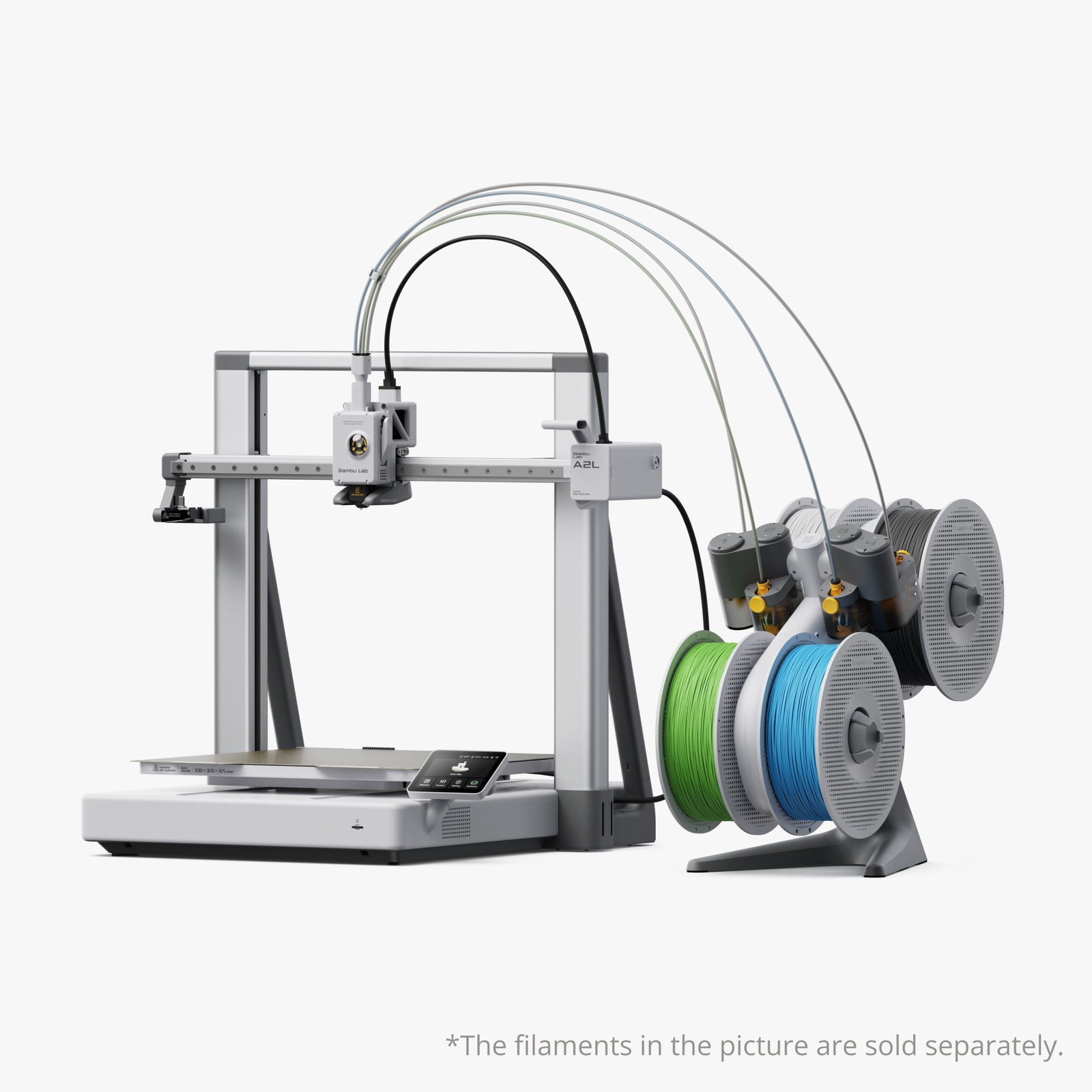
Short version: both printers share the same top speed, the same AMS Lite multi-color system, and the same full-auto calibration. Where they differ is bed size, extruder hardware, and max bed temperature — and that difference decides which one you should actually buy.
Quick Comparison Snapshot
| 🏆 Best Overall | Bambu Lab A2L Combo — bigger bed, upgraded servo extruder, and better vibration control for roughly the same buy-in as the A1 Combo. |
| 💰 Best Budget | Bambu Lab A1 Combo — lower upfront cost and a smaller footprint make it the easier first purchase. |
| ⚡ Fastest | Tie — both top out at 500 mm/s and 10,000 mm/s². Bambu didn’t slow the A2L down for its larger bed. |
| 📦 Largest Build Volume | Bambu Lab A2L Combo — 330 × 320 × 325 mm vs 256 × 256 × 256 mm, about 105% more usable volume. |
| 👨🎓 Best for Beginners | Bambu Lab A1 Combo — smaller, lighter, cheaper to experiment on, and just as automated as the A2L. |
| 🏭 Best for Businesses | Bambu Lab A2L Combo — larger parts per print and a sturdier extrusion system for repeat production. |
Introduction
Bambu Lab’s A-series is the default recommendation for anyone buying their first serious 3D printer. There are now two combo bundles worth comparing: the original A1 Combo and the newer, larger A2L Combo.
Both ship with AMS Lite for multi-color printing and Bambu’s full-auto calibration. On paper they look like siblings. In practice, differences in bed size, extruder hardware, and bed temperature change what each printer is actually good for.
This guide is for anyone comparing the two before spending money — beginners, hobbyists, engineers, product designers, schools, and small manufacturing teams. Expect an honest breakdown of specs, print quality, software, materials, and pricing, with a clear recommendation at the end.
Meet the Competitors
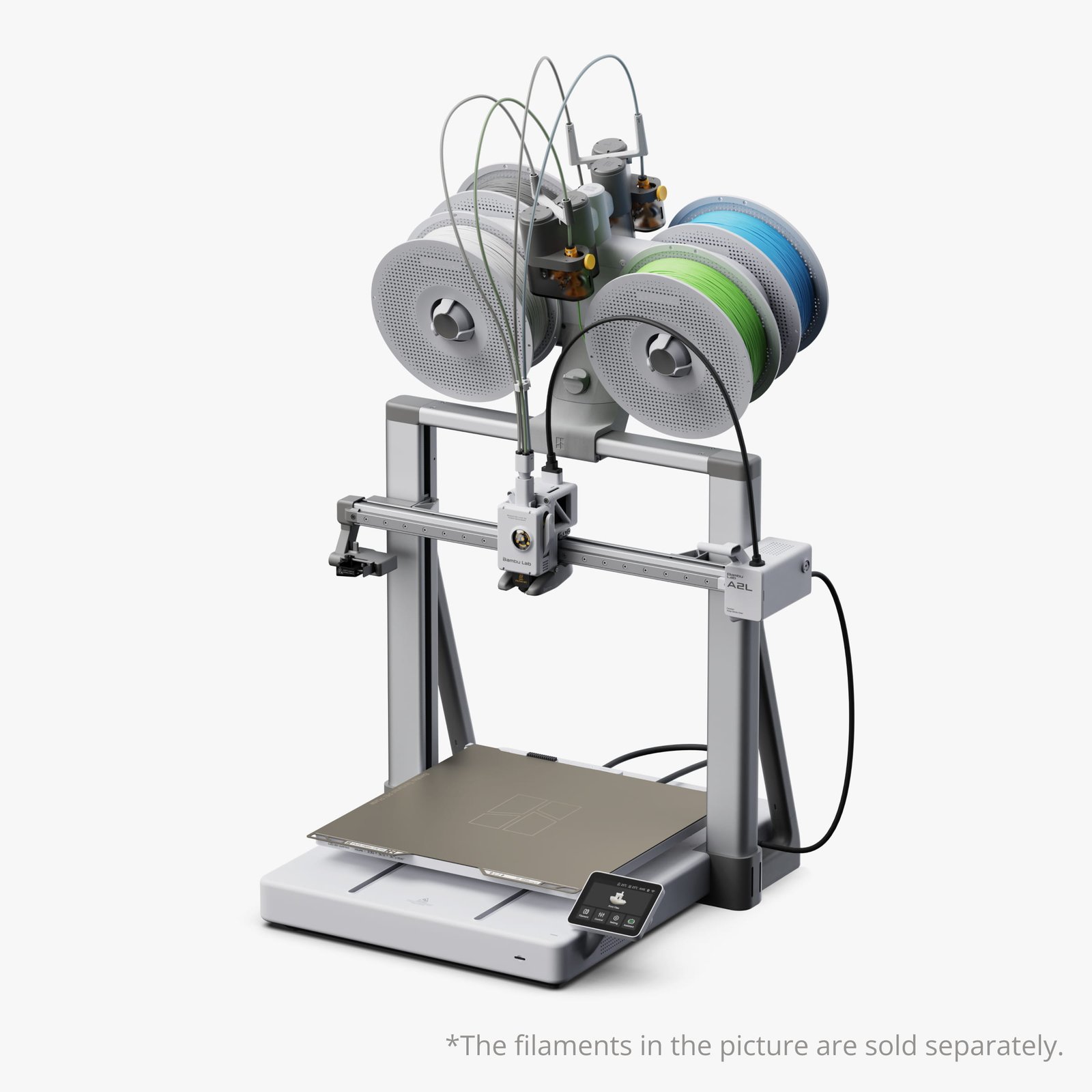
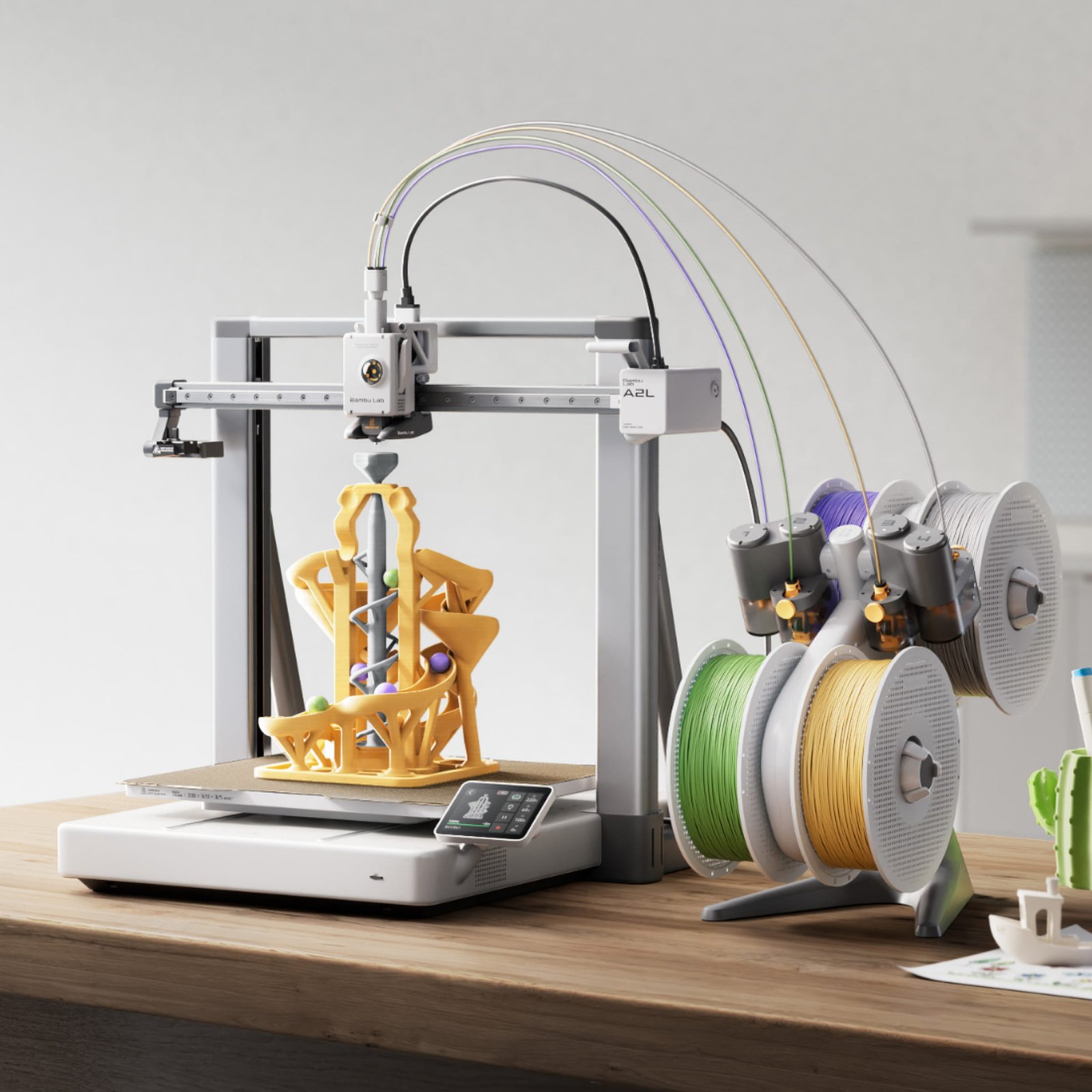
Bambu Lab A2L Combo
The large-format answer to the A1: bigger parts without stepping up to the P1S or X1 Carbon price bracket. It shares the A1’s core philosophy — open-frame, fast, auto-calibrating — but adds a 330 × 320 × 325 mm bed, an upgraded closed-loop servo extruder, and active vibration compensation.
It’s aimed at makers who keep hitting the size ceiling elsewhere: cosplay builders, product designers prototyping full-scale parts, schools running batch jobs, and small print farms that want fewer plates per job. See the full Bambu Lab A2L Combo listing for current stock and pricing.
Bambu Lab A1 Combo
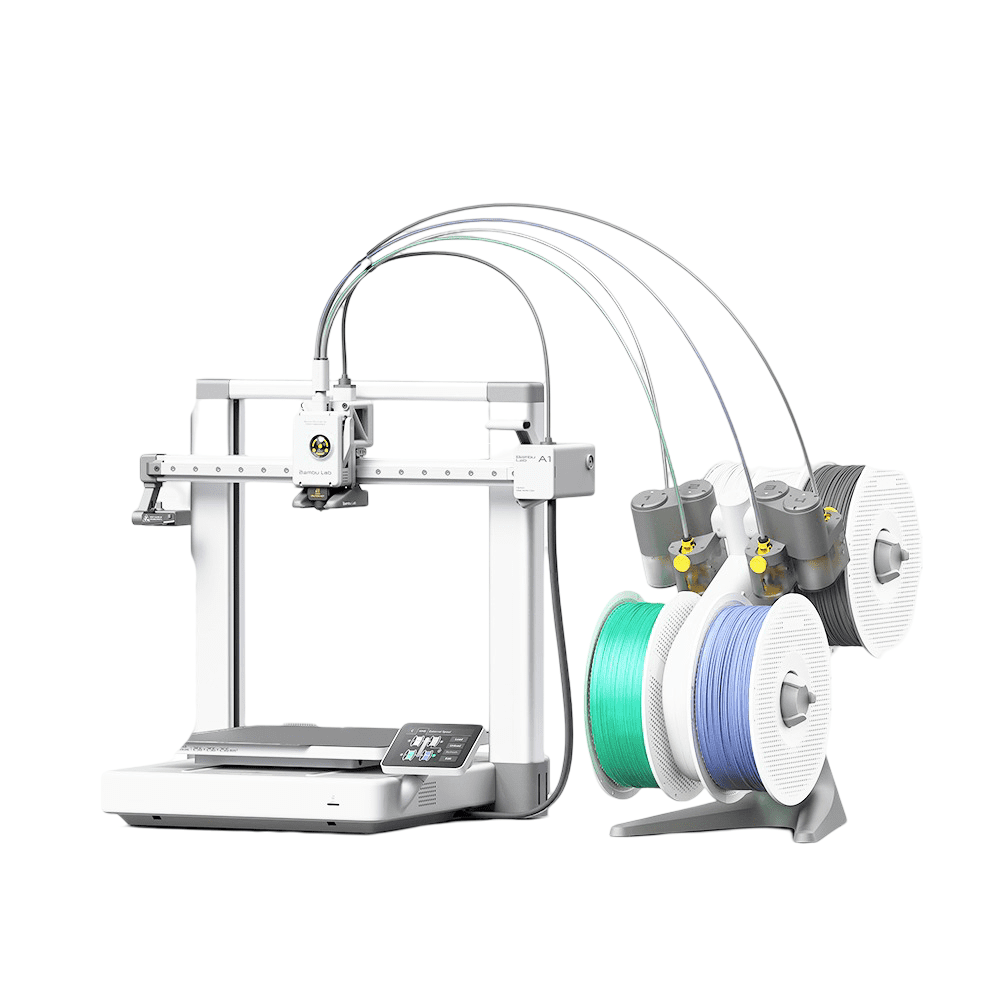
Bambu’s mainstream, do-everything printer since launch. A 256 × 256 × 256 mm open-frame machine with the same full-auto calibration, Active Flow Rate Compensation, and multi-color AMS Lite support the A2L inherited.
Built for beginners buying their first printer, hobbyists who don’t need a huge bed, classrooms, and anyone who wants a proven, well-documented machine at the lowest entry cost. See the full Bambu Lab A1 Combo listing for current stock and pricing.
A1 Combo
256 × 256 × 256 mm
A2L Combo
330 × 320 × 325 mm
A2L Combo build volume is roughly 105% larger than the A1 Combo
Technical Specifications
| Specification | Bambu Lab A2L Combo | Bambu Lab A1 Combo |
|---|---|---|
| Build Volume | 330 × 320 × 325 mm | 256 × 256 × 256 mm |
| Print Speed (max) | 500 mm/s | 500 mm/s |
| Acceleration (max) | 10,000 mm/s² | 10,000 mm/s² |
| Nozzle | 0.4 mm stainless steel (0.2/0.6/0.8 mm optional), 300°C max | 0.4 mm stainless steel (0.2/0.6/0.8 mm optional), 300°C max |
| Extruder | PMSM closed-loop servo, dual hardened-steel gears, active clog/blob detection | Standard stepper-driven extruder, hardened-steel gears |
| Bed Temperature (max) | 80°C | 100°C |
| Materials (rated) | PLA, PETG, TPU, PVA | PLA, PETG, TPU, PVA |
| Connectivity | Wi-Fi, Bambu Cloud or LAN-only mode | Wi-Fi, Bambu-Bus |
| Camera | Low-frame-rate monitoring camera, timelapse | Low-frame-rate monitoring camera, timelapse |
| AMS Support | AMS Lite included; up to 4 AMS/AMS Lite units chained | AMS Lite included; up to 4 AMS/AMS Lite units chained |
| Noise | ~49 dB (Silent Mode) / ~52 dB (Standard Mode) | Rated ~49 dB (real-world results vary by load) |
| Dimensions (printer only) | 544 × 529 × 505 mm | 385 × 410 × 430 mm |
| Net Weight | 12.8 kg | 8.3 kg |
| Power Input | 100-120 VAC / 200-240 VAC, 50/60 Hz | 100-240 VAC, 50/60 Hz, up to 1300 W @ 220V |
| Warranty | 1-year standard Bambu Lab warranty | 1-year standard Bambu Lab warranty |
Source: manufacturer specifications from Bambu Lab’s official A1 tech-specs page and A2L tech-specs page.
Here’s what matters from that table. Speed and acceleration are identical — Bambu didn’t sacrifice performance to grow the bed, a genuinely impressive engineering call.
The extruder is where the A2L pulls ahead. Its closed-loop servo motor runs thousands of checks per second on flow, catching clogs and grinding before they ruin a print — the A1’s extruder has no active monitoring.
The bed temperature swap is a real trade-off, not a typo. The A2L’s larger surface draws more power to heat, so Bambu capped it at 80°C for safety on standard home circuits — worth noting if you print a lot of PETG that likes a hotter bed.
Design & Build Quality
Both share the same open-frame, non-enclosed design: painted steel frame rails, extruded aluminum gantry, no side panels. Neither is CoreXY like the P1S or X1 Carbon.
Assembly is nearly tool-free on both — Bambu’s setup takes under 20 minutes, and AMS Lite click-fits onto the frame without screws on either model.
Footprint is where they diverge. The A2L needs roughly 544 × 529 × 505 mm of desk space versus the A1’s 385 × 410 × 430 mm — plan for a dedicated shelf if you’re going A2L.
Cable management and maintenance access are effectively identical: same belt-tensioning approach, same nozzle swap, same lubrication points.
Winner: A1 Combo. Not because it’s better built — the A2L uses the same materials and tolerances — but its smaller footprint and lighter 8.3 kg frame make it easier to place and live with day to day.
Print Performance
Print Quality
Both printers produce comparable surface finish on PLA and PETG at default profiles. Winner: Tie.
Speed
Identical rated top speed and acceleration on paper. Winner: Tie.
Accuracy
The A2L’s active vibration compensation and physical dampers reduce ringing and ghosting on larger, faster prints. Winner: A2L Combo.
Reliability
The A2L’s closed-loop servo extruder actively detects clogs and grinding mid-print; the A1 relies on passive sensors only. Winner: A2L Combo.
Long Prints
Larger bed means fewer plate changes for batch jobs, and the upgraded extruder reduces failed-print risk on multi-hour runs. Winner: A2L Combo.
Large Models
330 × 320 × 325 mm lets you print helmets, cosplay armor panels, and full-scale brackets in one piece that the A1 simply can’t fit. Winner: A2L Combo.
Overhangs
Both use the same part-cooling and flow-control hardware, so overhang performance is nearly identical at matched speeds. Winner: Tie.
Bridges
Same cooling system, same flow compensation — bridging quality comes down to your slicer profile, not the printer. Winner: Tie.
Multi-Color Printing
Both use the same AMS Lite and support chaining up to 4 units for 19-color prints. Winner: Tie.
Calibration
Both run Bambu’s full-auto calibration (bed level, flow, vibration) with zero manual tuning required. Winner: Tie.
Maintenance
Smaller mass and shorter belts on the A1 mean marginally quicker routine maintenance checks. Winner: A1 Combo.
Software Experience
Both printers run on Bambu Studio, Bambu Handy for mobile control, and support full remote monitoring through Bambu Cloud or a LAN-only mode for privacy-conscious users. Firmware updates, print history, and AMS filament tracking work identically across both machines.
There is no software gap between the two — the A2L doesn’t unlock any exclusive slicer features over the A1. Camera-based AI first-layer inspection and Live Spatial Alignment remain exclusive to Bambu’s H2-series, not either A-series printer.
Beginner friendliness is a dead heat: one-click print, cloud slicing, and MakerWorld model integration work the same way on both. Winner: Tie.
Material Compatibility
| Material | A2L Combo | A1 Combo |
|---|---|---|
| PLA | Ideal | Ideal |
| PETG | Ideal | Ideal |
| ABS | Not recommended | Not recommended |
| TPU | Ideal | Ideal |
| PETG-CF | Not officially rated | Not officially rated |
| PLA-CF | Not officially rated | Not officially rated |
| Engineering Materials (PC, PA, ASA) | Not recommended | Not recommended |
This is the biggest limitation both printers share. Neither is enclosed and neither has a heated chamber, so Bambu officially rates both for PLA, PETG, TPU, and PVA only. Engineering filaments are technically printable on either, but without chamber heat you’ll fight warping and delamination — that’s what the enclosed P1S, X1 Carbon, or H2D exist for.
If engineering-grade materials are a hard requirement, neither A1 nor A2L is the right printer — budget for an enclosed model instead.
Real World Applications
- Schools: A1 Combo — lower cost per unit makes buying several for a classroom realistic.
- Students: A1 Combo — smaller footprint fits dorm rooms and shared workspaces.
- Prototype Development: A2L Combo — larger bed means fewer split prints for full-scale parts.
- Architecture: A2L Combo — large-format models print in one piece, not glued sections.
- Cosplay: A2L Combo — armor panels and helmets fit the 330 mm bed without splitting.
- Product Design: A2L Combo — bigger parts and the upgraded extruder reduce failed overnight prints.
- Manufacturing: A2L Combo — larger batches per plate and active clog detection cut downtime.
- Print Farms: A2L Combo — fewer machines needed to hit the same daily output.
- Automotive: A2L Combo — larger brackets and housings print without multi-part assembly.
- Medical (non-clinical models, jigs): A1 Combo — smaller parts, tight tolerances, lower cost for volume testing.
- Jewellery: A1 Combo — small parts don’t benefit from bed size; precision matters more.
- Robotics: A2L Combo — chassis plates and structural components fit without splitting.
Pros & Cons
Bambu Lab A2L Combo
Pros:
- 105% larger build volume than the A1
- Closed-loop servo extruder with active clog detection
- Adaptive vibration compensation for cleaner large prints
- Modular platform supports optional cutting/plotting add-ons
- Same top speed as the A1 despite the bigger bed
Cons:
- Lower max bed temperature (80°C vs 100°C)
- Larger footprint needs more desk space
- Higher upfront cost
- Heavier at 12.8 kg net weight
Bambu Lab A1 Combo
Pros:
- Lower price, easier first purchase
- Compact footprint, fits most desks
- Higher max bed temperature (100°C)
- Proven, widely documented, huge community support
Cons:
- Passive-only extruder monitoring, no active clog detection
- Smaller bed limits large single-piece prints
- No vibration-compensation hardware
- No modular tool-head expansion path
Price & Value
In India, the A1 Combo is priced at approximately ₹48,999 (with AMS Lite), and the standalone A1 at approximately ₹31,999. The A2L Combo carries a street price of approximately ₹65,999 through authorized Bambu Lab resellers.
Both boxes include the printer, AMS Lite unit, spool holders, PTFE tubing, a pre-installed nozzle, sample filament, and the standard accessory kit. Prices shift with regional promotions, so confirm current numbers before you buy.
Maintenance cost is comparable — both share nozzle, hotend, and extruder-gear parts through Bambu’s spares catalog. The A2L’s larger bed draws more power during heating, so expect a modestly higher electricity cost if you run it constantly. Consumables are shared across the A-series, so switching between the two doesn’t change running costs meaningfully.
For long-term ownership, the A2L’s extra roughly ₹17,000 buys real hardware upgrades, not just a bigger bed. If your projects regularly need the extra volume or active clog protection, it pays for itself in fewer failed prints.
Who Should Buy Which Printer?
Choose A2L Combo if…
You regularly print parts larger than 256 mm, run unattended overnight prints, or need the reliability of active clog detection for production work.
Choose A1 Combo if…
You’re buying your first 3D printer, have limited desk space, or don’t need the extra bed size for your typical projects.
Don’t buy A2L if…
Your prints are consistently small, your budget is tight, or you print a lot of PETG that benefits from a hotter 100°C bed.
Don’t buy A1 if…
You’re chasing large-format cosplay props, architectural models, or production parts that need the extra volume — you’ll outgrow it fast.
Frequently Asked Questions
Is the Bambu Lab A2L Combo worth the extra money over the A1 Combo?
Yes, if you regularly need the larger bed or active clog-detection extruder. If your prints comfortably fit within 256 mm, the A1 Combo delivers the same quality for less.
Does the A2L print faster than the A1?
No. Both are rated for the same 500 mm/s max speed and 10,000 mm/s² acceleration — the larger bed doesn’t slow the A2L down, but it doesn’t speed it up either.
Can either printer handle ABS or carbon-fiber filament?
Not officially. Both are open-frame printers without a heated chamber, so Bambu rates them for PLA, PETG, TPU, and PVA only. CF-reinforced and engineering filaments need an enclosed printer like the P1S or X1 Carbon.
Why does the A2L have a lower max bed temperature than the A1?
Its larger heatbed draws more power to reach the same temperature, so Bambu capped it at 80°C to keep power draw within safe limits for standard home circuits.
Is AMS Lite the same on both printers?
Yes. Both use the identical unit and support chaining up to four AMS/AMS Lite units for multi-material, up to 19-color printing.
Which printer is better for a school or classroom?
The A1 Combo, in most cases. Its lower per-unit cost lets you buy more printers for the same budget, and most classroom projects don’t need the extra bed size.
Does the A2L support laser cutting or engraving?
The A2L uses a modular tool-head platform with optional add-on modules for cutting and pen plotting. Availability depends on your region and current Bambu Lab accessory catalog.
Which printer has better long-term reliability?
The A2L’s closed-loop servo extruder actively monitors for clogs and grinding in real time, reducing failed prints on long or unattended jobs versus the A1’s passive sensors.
Final Verdict
Best Budget Choice: Bambu Lab A1 Combo. Lower cost, smaller footprint, same core auto-calibration and multi-color capability.
Best Professional Choice: Bambu Lab A2L Combo. Active clog detection and vibration compensation matter most when you’re printing for clients or production, not hobby projects.
Best Hobby Choice: Bambu Lab A1 Combo. Most hobby prints don’t need 330 mm of bed space, and the lower price leaves more budget for filament.
Best Large Format Printer: Bambu Lab A2L Combo, by a wide margin — there’s no other Bambu A-series printer close to its build volume at this price.
Best Overall Winner: Bambu Lab A2L Combo. It matches the A1’s speed, keeps the same auto-calibration and AMS ecosystem, and adds a genuinely better extruder and a much larger bed for a moderate price increase. The A1 Combo remains the smarter buy only if budget or desk space is the deciding factor — a completely valid reason to choose it.
Still Not Sure Which One Fits Your Projects?
Don’t guess with your budget. Talk to Voxelstudio’s 3D printing team for a free consultation — we’ll match the right Bambu Lab printer to your build volume, material, and budget requirements. No sales pressure, just an honest recommendation based on what you’re actually printing.
- 📞 Call us: +91-8091391371
- 💬 WhatsApp us: Chat now
- 🖥️ Book a free live demo at our Greater Noida studio
- 📄 Request a formal quotation for your business or institution